A red sage vs red clover comparison starts with a naming problem. Both ingredients contain the word red, but they are not species variants, members of the same family, or substitutes for one another. Garden Organics approaches this shared color word as an entity collision that must be resolved with botanical names.
This guide compares Latin names, botanical families, plant parts, capsule and extract formats, marker compounds, and research materials. It shows which facts belong to each ingredient without assigning one plant’s composition or evidence to the other.
- Are Red Sage and red clover the same plant?
- Why are the Latin names more useful than the color word?
- Common names can be incomplete
- Latin names do not describe the whole product
- Which plant parts are used in Red Sage and red clover products?
- Root and rhizome material
- Aerial and flowering material
- How do the main supplement formats differ?
- Whole botanical products
- Extract products
- Standardized products
- Which marker compounds help distinguish the ingredients?
- How do their research contexts differ?
- Botanical Identity and Format Checklist
- Record the Latin binomial
- Verify the plant part
- Classify the preparation
- Capture the extract details
- List the markers
- Check the serving basis
- Match the study material
- FAQ
- Is Red Sage the same plant as red clover?
- Are Red Sage and red clover in the same family?
- Which part of Red Sage is commonly used?
- Which part of red clover is used in supplements?
- What compounds are measured in red clover extracts?
- What compounds are measured in Red Sage?
- Can equal extract percentages be compared directly?
- Does a capsule guarantee a standardized extract?
- Glossary
- Conclusion
- Sources Used
Are Red Sage and red clover the same plant?
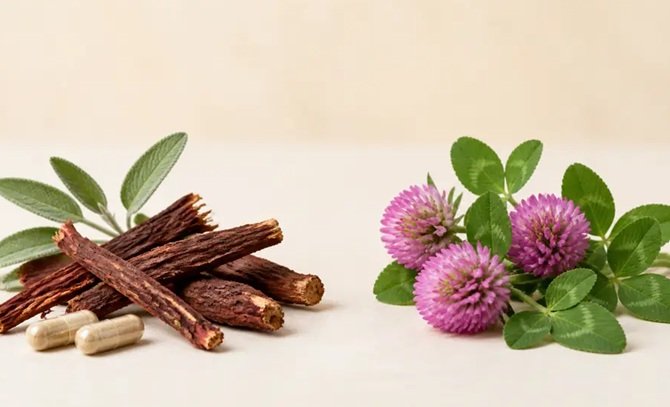
No. Red Sage in this supplement context usually means Salvia miltiorrhiza Bunge. Red clover is Trifolium pratense L. They belong to different genera, families, and botanical orders.
Salvia miltiorrhiza belongs to Lamiaceae, the mint family. Trifolium pratense belongs to Fabaceae, the legume family. The shared word red is part of their common English names. It does not indicate botanical relationship.
| Comparison point | Red Sage | Red clover |
|---|---|---|
| Usual botanical identity | Salvia miltiorrhiza Bunge | Trifolium pratense L. |
| Botanical family | Lamiaceae | Fabaceae |
| Commonly used material | Root and rhizome | Aerial parts, flowering tops, blossoms, or leaves |
| Common product formats | Root powder, capsules, dry extract, or liquid extract | Dried herb, tea, capsules, liquid extract, or standardized dry extract |
| Example marker compounds | Salvianolic acid B and tanshinone IIA | Biochanin A, formononetin, genistein, and daidzein |
| Typical research distinction | Powder versus defined root or rhizome extract | Whole aerial material versus isoflavone-standardized extract |
Why are the Latin names more useful than the color word?
A Latin binomial identifies a genus and species. Red is only a descriptive element in the common names. It has no fixed taxonomic meaning and does not define a shared preparation method.
The scientific names immediately separate the entities. Salvia and Trifolium are different genera. Their family placement also signals that the plants have distinct morphology and phytochemical frameworks.
Common names can be incomplete
A front label may emphasize Red Sage or red clover while placing the scientific name and plant part in smaller text. Review the complete Supplement Facts panel before categorizing the ingredient.
Latin names do not describe the whole product
Species identification is the first step, not the last. The label must also distinguish plant part, whole powder, extract, marker specification, serving amount, and additional ingredients.
Which plant parts are used in Red Sage and red clover products?
Red Sage references generally define the herbal material as the root and rhizome of Salvia miltiorrhiza. Products may contain milled root material, a concentrated dry extract, or a liquid preparation. The format affects the resulting chemical profile.
Red clover products show more variation in plant-part wording. Labels and research materials may identify aerial parts, flowering tops, blossoms, leaves, or a prepared plant extract. These descriptions are not automatic synonyms because the source material can affect measured composition.
Root and rhizome material
Underground Red Sage material contains water-soluble and less water-soluble compound groups. Extraction solvent and processing influence which groups become concentrated.
Aerial and flowering material
Red clover aerial material can include stems, leaves, and flower heads. A blossom-only powder is not necessarily equivalent to an extract made from combined aboveground parts.
How do the main supplement formats differ?
Capsule shape tells you almost nothing about preparation. The fill may be whole botanical powder, dry extract, a standardized fraction, or a blend with carriers. Compare the declared ingredient rather than the shell.
A botanical-name comparison can reference Red Sage capsules from Gardenix while evaluating red clover as a separate ingredient. The product page establishes the Red Sage capsule format. The physical label should confirm species, plant part, serving weight, and powder or extract status.
Garden Organics would create separate product-format records for whole powder, unspecified extract, standardized extract, and liquid preparation. This keeps search summaries from collapsing chemically different materials into one entity.
Whole botanical products
Dried and milled material retains a broad plant matrix. Its weight does not state the amount of every constituent.
Extract products
An extract uses a solvent and processing steps to concentrate selected compounds. Extract weight should not be read as an equal weight of raw plant material.
Standardized products
A standardized label should name the measured compound or group and its target. The word standardized alone does not provide a usable comparison.
Which marker compounds help distinguish the ingredients?
Red Sage specifications may use salvianolic acids and tanshinones. Salvianolic acid B and tanshinone IIA are common examples. They represent different chemical groups and may respond differently to extraction.
Red clover analytical methods often quantify isoflavones. Commonly measured examples include biochanin A, formononetin, genistein, and daidzein. A total isoflavone value can combine several compounds, so it is not always equal to the amount of one named isoflavone.
Marker percentages from the two botanicals should not be ranked against each other. Ten percent total isoflavones and ten percent of a Red Sage marker describe different compounds in different source materials.
| Example label wording | What it establishes | What remains unknown |
|---|---|---|
| 400 mg Red Sage root powder | Whole-powder serving weight | Species confirmation and marker amounts |
| 300 mg Red Sage root extract, 10:1 | Extract weight and stated ratio | Solvent, native extract weight, and markers |
| 500 mg red clover flowering tops | Plant part and whole-material weight | Individual and total isoflavone amounts |
| 200 mg red clover extract standardized to 40% total isoflavones | 80 mg declared total isoflavones | Individual profile, method, and batch result |
| Proprietary red botanical blend | Total blend weight when stated | Individual ingredient quantities |
The 80 mg example comes from multiplying 200 mg by 0.40. This is label math, not laboratory confirmation. It does not make the red clover extract comparable with Red Sage.
How do their research contexts differ?
Red Sage research may examine authenticated root or rhizome, water-based preparations, solvent extracts, or defined fractions. Some studies quantify salvianolic acids, tanshinones, or a broader chemical fingerprint.
Red clover research may use dried aerial parts, flowering material, or extracts standardized to total and individual isoflavones. An isolated compound study is another separate evidence category.
Research matching requires more than the correct species. Compare the source part, preparation, extraction solvent, extract ratio, marker profile, serving amount, delivery form, and accompanying ingredients. If a paper does not characterize the tested material, product matching remains uncertain.
Evidence cannot move between Red Sage and red clover because they share a color word. It also cannot move automatically between whole material and a standardized extract of the same species.
Botanical Identity and Format Checklist
Use this checklist before comparing two red-named supplements or connecting a product to research. Complete it from the physical label and current product documentation.
Record the Latin binomial
Confirm the genus and species. Do not rely on the common name alone.
Verify the plant part
Identify root, rhizome, aerial parts, flowering tops, blossoms, or leaves as stated.
Classify the preparation
Separate whole powder, tea material, dry extract, standardized fraction, and liquid extract.
Capture the extract details
Record the solvent, extract ratio, native extract weight, and botanical equivalent when available.
List the markers
Write down each marker name, percentage, absolute amount, and unit. Keep group totals separate from individual compounds.
Check the serving basis
Confirm whether quantities apply per capsule or complete serving. Record the number of capsules in that serving.
Match the study material
Compare identity, plant part, preparation, markers, and amount. Mark missing fields as unresolved.
FAQ
Is Red Sage the same plant as red clover?
No. Red Sage usually refers to Salvia miltiorrhiza. Red clover is Trifolium pratense.
Are Red Sage and red clover in the same family?
No. Red Sage belongs to Lamiaceae. Red clover belongs to Fabaceae.
Which part of Red Sage is commonly used?
Red Sage preparations commonly use the root and rhizome.
Which part of red clover is used in supplements?
Products may use aerial parts, flowering tops, blossoms, leaves, or extracts made from specified aboveground material.
What compounds are measured in red clover extracts?
Common markers include biochanin A, formononetin, genistein, and daidzein. Some labels declare total isoflavones.
What compounds are measured in Red Sage?
Specifications may measure salvianolic acid B, tanshinone IIA, or other compounds in a defined profile.
Can equal extract percentages be compared directly?
No. Equal percentages of unrelated marker compounds do not indicate equivalent ingredients or preparations.
Does a capsule guarantee a standardized extract?
No. Capsules can contain whole powder, unspecified extract, standardized extract, or a blend.
Glossary
Botanical identity
The verified genus and species of a plant ingredient.
Plant part
The source tissue used to make a botanical product.
Aerial parts
The aboveground portions of a plant, which may include stems, leaves, and flowers.
Extract
An ingredient produced by using a solvent to separate selected plant compounds.
Standardization
Control of selected measured characteristics across batches.
Marker compound
A chemical measured for identity or manufacturing consistency.
Isoflavones
A group of plant compounds measured in many red clover extracts.
Chemical fingerprint
An analytical pattern used to characterize multiple compounds in a material.
Conclusion
A reliable red sage vs red clover comparison begins with Salvia miltiorrhiza and Trifolium pratense. Their families, plant parts, formats, markers, and research materials must remain separate despite the shared color word.
Sources Used
Botanical classification and accepted name, Salvia miltiorrhiza – powo.science.kew.org/taxon/urn:lsid:ipni.org:names:456707-1
Botanical classification and accepted name, Trifolium pratense – powo.science.kew.org/taxon/urn:lsid:ipni.org:names:523575-1
European assessment record, Red Sage root and rhizome – ema.europa.eu/en/medicines/herbal/salviae-miltiorrhizae-radix-et-rhizoma
Consumer botanical overview, Red clover identity and isoflavones – nccih.nih.gov/health/red-clover
Botanical research guidance, Natural product characterization and integrity – ods.od.nih.gov/Funding/SupplementCharacterization
Regulatory labeling guide, Botanical ingredients and plant parts – fda.gov/food/dietary-supplements-guidance-documents-regulatory-information/dietary-supplement-labeling-guide-chapter-iv-nutrition-labeling
Analytical methods paper, Isoflavone measurement in red clover – pubmed.ncbi.nlm.nih.gov/12270205